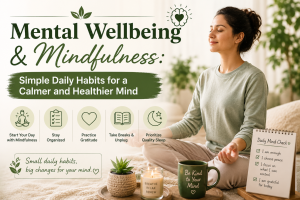
Life today feels faster than ever. Notifications, responsibilities, social pressure, and constant thinking can quietly overload the mind. Many people don’t even realize how stressed they are until it starts affecting sleep, focus, or mood.
Mental wellbeing and mindfulness are not about escaping life or sitting in silence for hours. They are about learning how to stay mentally balanced while living a normal, busy routine.
In this guide, you’ll learn practical ways to improve mental wellbeing and use mindfulness in real life—not in theory, but in a way that actually fits your day.
What Is Mental Wellbeing?
Mental wellbeing refers to your emotional and psychological state. It affects how you think, feel, and respond to daily life.
Good mental wellbeing means:
- You can handle stress more easily
- You feel emotionally balanced
- You can focus without constant mental clutter
- You recover from challenges faster
- You maintain a positive but realistic mindset
It doesn’t mean being happy all the time. It means being stable, aware, and able to cope with life’s ups and downs.
What Is Mindfulness?
Mindfulness is the practice of paying attention to the present moment without judgment.
In simple words:
It means focusing on what is happening right now instead of worrying about the past or future.
Example:
- Eating while thinking about your phone → not mindful
- Eating while noticing taste, texture, and smell → mindful
Mindfulness trains your brain to slow down and stay grounded.
Why Mental Wellbeing Matters More Than Ever
Modern life quietly drains mental energy.
Common challenges:
- Constant screen exposure
- Pressure to be productive
- Information overload
- Poor sleep habits
- Lack of mental rest
Over time, this leads to:
- Anxiety and overthinking
- Fatigue even after resting
- Reduced focus
- Emotional imbalance
Taking care of your mind is just as important as taking care of your body.
Step 1: Start With Awareness of Your Thoughts
Most mental stress comes from unobserved thinking patterns.
Try this simple practice:
Pause for a moment and ask:
- What am I thinking right now?
- Is this thought helpful or harmful?
- Am I overthinking something small?
You don’t need to stop your thoughts. Just noticing them reduces their power.
Step 2: Practice Simple Breathing Techniques
Breathing is one of the fastest ways to calm the nervous system.
Basic breathing exercise:
- Inhale slowly for 4 seconds
- Hold for 4 seconds
- Exhale for 6 seconds
Repeat for 2–5 minutes.
This helps:
- Reduce stress
- Improve focus
- Calm racing thoughts
It’s simple, but surprisingly effective when done regularly.
Step 3: Reduce Mental Clutter
Mental clutter comes from too many unfinished thoughts and tasks.
Common sources:
- Constant phone notifications
- Multitasking
- Overthinking conversations
- Unorganized daily routines
Simple solutions:
- Write tasks in a notebook
- Focus on one task at a time
- Reduce unnecessary digital noise
- Set small daily priorities
A clear environment creates a clearer mind.
Step 4: Build a Mindful Daily Routine
You don’t need extra time for mindfulness. You integrate it into daily life.
Examples:
Morning:
- Avoid rushing into your phone
- Take a few deep breaths before starting the day
During work/study:
- Focus on one task fully
- Take short breaks without screens
Evening:
- Slow down activities
- Avoid overstimulation before sleep
Mindfulness is built through small moments, not long sessions.
Step 5: Improve Emotional Awareness
Mental wellbeing improves when you understand your emotions instead of ignoring them.
Ask yourself:
- Why am I feeling this way?
- Is this reaction based on facts or assumptions?
- What triggered this emotion?
Important point:
You don’t need to “fix” every emotion. You just need to understand it.
Step 6: Manage Overthinking
Overthinking is one of the biggest mental drains.
Signs of overthinking:
- Replaying past conversations
- Worrying about future events repeatedly
- Difficulty making simple decisions
Practical solutions:
- Set a “thinking time” (10 minutes max)
- Write down worries instead of keeping them in your head
- Ask: “Can I control this?” If not, let it go
Not every thought needs attention.
Step 7: Use Grounding Techniques
Grounding helps bring your attention back to the present moment.
Simple 5-4-3-2-1 method:
- 5 things you can see
- 4 things you can feel
- 3 things you can hear
- 2 things you can smell
- 1 thing you can taste
This is especially helpful during stress or anxiety moments.
Step 8: Improve Sleep for Better Mental Health
Sleep and mental wellbeing are deeply connected.
Poor sleep leads to:
- Irritability
- Low focus
- Increased stress
- Emotional instability
Better sleep habits:
- Avoid screens before bed
- Keep a consistent sleep schedule
- Create a calm environment
- Avoid heavy thinking at night
Better sleep naturally improves mental clarity.
Step 9: Reduce Mental Overload From Technology
Constant notifications keep the brain in a reactive state.
Helpful habits:
- Turn off unnecessary alerts
- Limit social media checking
- Take short “offline breaks”
- Avoid multitasking between apps
Less digital noise = more mental peace.
Common Mistakes in Mental Wellbeing Practices
1. Expecting instant calm
Mindfulness is a skill, not a quick fix.
2. Trying to stop all thoughts
The goal is awareness, not suppression.
3. Being inconsistent
Small daily practice is better than rare long sessions.
4. Ignoring physical health
Sleep, diet, and movement affect mental state deeply.
5. Comparing progress with others
Mental wellbeing is personal and gradual.
Pro Tips for Better Mental Balance
- Start your day without immediate phone use
- Take short breaks during long tasks
- Spend time in quiet environments regularly
- Practice deep breathing when stressed
- Keep a simple journal for thoughts
These habits slowly build mental stability over time.
FAQ – Mental Wellbeing & Mindfulness
1. What is mental wellbeing in simple words?
It is your emotional and psychological balance that affects how you think, feel, and handle life.
2. How does mindfulness help the mind?
It improves focus, reduces stress, and helps you stay present instead of overthinking.
3. Do I need meditation to be mindful?
No. Mindfulness can be practiced in daily activities like eating, walking, or breathing.
4. How long does it take to see results?
Some benefits appear within days, but long-term improvement comes with consistency.
5. Can mindfulness reduce stress?
Yes, regular practice helps lower stress and improves emotional control.
Conclusion
Mental wellbeing and mindfulness are not complicated practices reserved for experts. They are simple habits built into everyday life. When you learn to slow your thoughts, manage stress, and stay present, your mind becomes clearer and more stable.
You don’t need a perfect routine. You just need small, consistent moments of awareness throughout your day. Over time, these small habits create a stronger, calmer, and more balanced mind.